
One tie leads to another
Prehistoric men hung the dried testicles of enemies killed in battle around their necks, thus demonstrating their value and status within a primitive society.
At the time of the ancient Egyptians when, during funeral rites, small strips of colored fabric were tied around the neck of the dead.
The Roman legionaries wore a piece of fabric around their necks and used it to protect the airways from dust during long marches.
Eustache Deschamps French poet and writer (1346-1406) wrote a ballad entitled "Faite restraindre sa cravate" or tie up his tie.
Cesare Vecellio Venetian painter and draftsman (1530-1601), in a richly illustrated book published in 1590 in Venice and dedicated to all the costumes of the world, we find the word "tie" written.
The Thirty Years War (1618-1648). On the French front, the best fighters were the Croatian knights. When the war ended, these soldiers made a parade in front of King Louis XIV as heroes and during this occasion they wore colored fabric around their necks.
So let's say that the most reliable origin regarding the introduction of the tie in European fashion takes us back to 1661. King Louis XIV was a fashion-conscious person, he was immediately impressed by this new style and became enthusiastic about it. He entrusted the assignment of the king's tie to the court tailor, this person had the task of helping the King both in choosing and tying the tie. He fell in love with it and immediately began to wear it, spreading the fashion first in France and later throughout the world.
There are depictions dating back to the early fourteenth century that portray Chinese warriors wearing a handkerchief around their neck.
The ties and their origins
What is certain is that ties, as we know and wear them, were invented in England in 1850. A few years later they also arrived in our country where they immediately played a leading role.
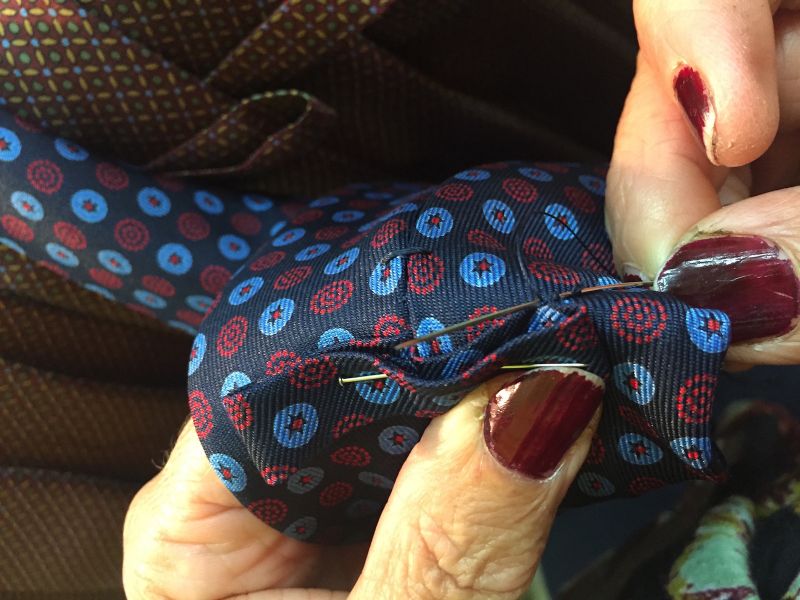
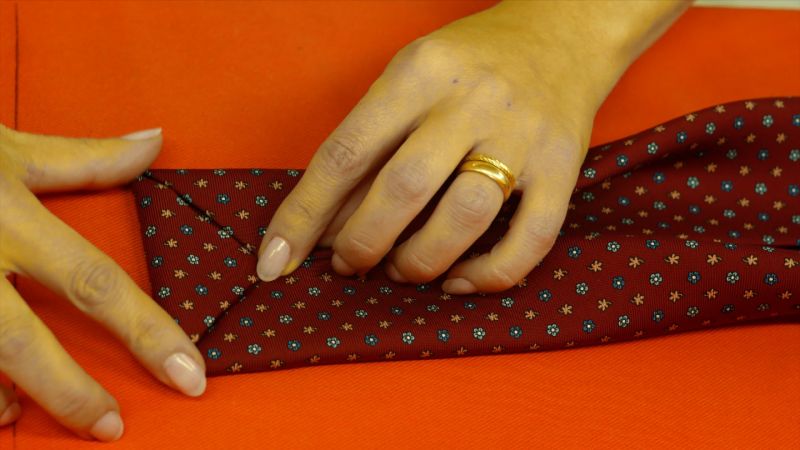
Today Italy certainly has an undisputed leading role in the production of tailored ties with the queen of ties: "the seven folds". The seven fold tie gets its name from the way it is sewn. It is a single piece of silk that is folded 7 times without adding padding. The seven folds can be unlined or lined. In this last case there is no canvas interior. A seven-fold tie is more expensive because it requires more fabric and more careful workmanship, but it has an incredible hand (i.e. the feel in the hand is heavier and better). The multiple advantages of the 7-fold tie are therefore: the fall, its tightness and the way of falling are flawless give a flatter seal and closer to the body under the jacket or vest, the ability to create original folds at the exit of the node.
Small curiosities about ties
I conclude with some curiosities that you may not know.
Starting in 1924, the hitherto practiced method of cutting the fabric at a right angle to the direction of the weft instead of parallel has become established. American Jesse Langdsdorf invented this improvement and had it patented under the brand name Resilio. Since that time very little has changed in the creation of ties. The products differ only in the quality of the materials and reinforcement, in the quantity of the fabric worked and the percentage of work done by hand.
Over the years it has even been at the center of several works of art, such as Modigliani's "Portrait of a woman with a black tie"; and also made famous by some iconic characters from the world of cinema, from the Blues Brothers to Christian Gray, who have made it a true cult.
The tie has even been the subject of study by a well-known Swedish mathematician, Mikael Vejdemo-Johansson, who has applied himself for a long time and thanks to complex mathematical models has experimented with over 200,000 ways to tie it.
The ties even have their own celebratory day, in fact starting from 2003, on October 18 of each year we celebrate the Tie Day. It all started when the Cravatic Academy of Croatia wrapped around the Roman arena in Pola, a gigantic red tie 808 meters long, to pay homage to the symbol of the national identity of the country. In 2008 the Croatian parliament unanimously declared "Tie Day" on October 18th.
Share